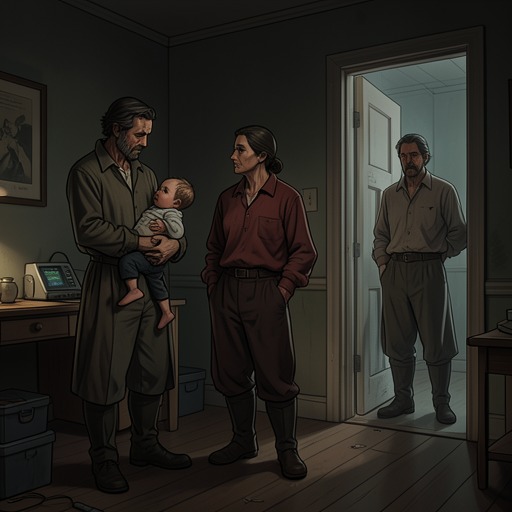
Frank damages his right hand after learning his daughter may also eat people
Bones & AllFrank Yearly’s destruction of his writing hand is the bodily consequence of learning that his daughter, Maren, may share his hunger for human flesh. The event is disclosed not in a continuous scene of injury but through the damage’s traces: Frank’s notebook records his hand’s loss of function, and Travis later explains how his attempt to reassure Frank supplied the knowledge that made him fear for Maren. Its force lies in that reversal: evidence meant to show Frank he was not alone instead made him confront what his condition might mean for his child.
Background and Cause
Travis tells Maren that he spent months looking for people who could prove that Frank was not the only person with the condition. He knew the search was dangerous, but hoped that finding others like Frank would help him. His account establishes that the information was not offered as a threat or accusation; he intended it as reassurance. Yet the discovery carried a consequence he had not anticipated: if Frank was not alone, then Maren might not be separate from him either.
Travis says that he knew Maren would come to him and that she would be like her father. In his explanation, this is the connection Frank had not previously considered. Learning that others shared the condition made the possibility of its presence in his daughter newly legible to him. Travis believes that telling Frank what he had learned turned a well-meant effort to ease isolation into the cause of a deeper crisis.
The Injury in Frank’s Notebook
The notebook gives the event a fractured, material record. One entry says that Frank’s pencils have been taken away; a later page, written in red crayon, announces, “Today I ruined the hand I write with.” The brief statement is followed by the insistence “HAND IS GONE,” repeated across the page. The change of writing instrument and the repeated declaration make the injury visible through the very activity it has interrupted: Frank can still write, but the hand that enabled his writing has become the subject of the record.
When Maren asks what the entry means, Frank’s response is physical rather than explanatory. With his eyes still shut, he withdraws his left hand and lets it fall into his lap to shield the right. His face crumples, while Travis looks at the floor. The scene does not specify how Frank injured himself, and the notebook does not narrate the act itself. Instead, the withheld mechanics leave the reader with its aftermath: the injured hand, Frank’s effort to conceal it, and the repeated words on the page.
Travis’s Confession and Frank’s Motive
Travis eventually tells Maren directly that he considers himself responsible for what Frank did to himself. He had searched for evidence that Frank was not alone, but had failed to reckon with what that knowledge would imply about Frank’s daughter. Travis describes Frank as devastated when the possibility occurred to him. He connects that realization to the mutilation, saying that Frank acted because he learned Maren might be like him.
The confession does not make Travis’s intention and its consequence the same thing. He wanted to help Frank, yet his effort brought Frank face to face with a fear about his child. Travis therefore reads the injury as both a response to the news and a failure of his own judgment. His repeated self-blame—his belief that he tries to help but ruins everything—shows how the event continues to shape his understanding of his actions. Maren tells him it was not his fault, though she wishes he had not told her; Travis admits that he does not believe her reassurance, even as hearing it makes him feel better.
Disclosure and Significance
The event reaches Maren through two imperfectly overlapping forms of testimony: Frank’s terse notebook entries and Travis’s later explanation. The notebook supplies the immediate marks of distress but not its cause; Travis supplies the causal account, including his own role, but recounts it through guilt. Maren is thus made to assemble the event from what Frank wrote, what his body reveals, and what Travis can bring himself to say.
That delayed disclosure gives the right hand a significance beyond the injury alone. Frank’s inability to write as before is recorded in the pages that also preserve his fear, while the name “Janelle,” written over and over at the notebook’s end, leaves his attachment to Maren’s mother as the final visible recurrence in the pages Maren reads. The notebook does not explain that repetition, so it cannot be treated as a definitive account of Frank’s motive. It does, however, place the hand’s ruin within a record marked by loss and repeated names. The event’s central consequence is therefore both bodily and familial: Frank’s fear of what Maren might inherit becomes legible to her through the injury he tried to hide and the words he left behind.